

The lead generation illusion
Lead generation has become one of modern marketing’s most inflated promises. Every platform claims to deliver “high-intent audiences”, every dashboard glows with attributed conversions, and every AI tool insists it can optimise its way to growth.
Yet beneath the language of automation and efficiency sits a more uncomfortable reality: most businesses still struggle to identify which leads actually matter.
Volume has become easy. Quality remains stubbornly difficult.
That distinction increasingly defines the gap between companies producing spreadsheets full of form fills and those building genuine commercial momentum.
Search behaviour is becoming more complex
The mechanics of online discovery are changing rapidly. Search is no longer confined to short keyword phrases typed into a browser bar. Consumers increasingly use voice, images, conversational prompts and AI-assisted discovery experiences to research products and services.
Visual search activity has surged, while AI-powered interfaces are encouraging users to ask longer, more specific and more contextual questions. That shift matters because query length increasingly reflects commercial intent.
A broad search may indicate early-stage curiosity. A highly detailed query often signals active evaluation, comparison or purchase readiness. For marketers, the challenge is no longer simply attracting attention. It is understanding intent with enough precision to identify which prospects are genuinely valuable.
The lead funnel has become a measurement problem
Many businesses still optimise around the easiest metrics to obtain: form fills, downloads, registrations or click-through rates. But modern lead generation increasingly depends on understanding what happens after the initial conversion.
There is a substantial difference between a lead, a marketing-qualified lead, a sales-qualified lead and an eventual customer. Yet many businesses continue to optimise campaigns as though those stages carry equal commercial value.
Advertising platforms are moving beyond simply counting conversions. Increasingly, they attempt to identify which interactions lead to actual business outcomes. This is where offline conversion tracking and enhanced lead measurement become strategically important. Systems that connect CRM outcomes back into advertising platforms allow campaigns to optimise towards customers rather than enquiries alone.
The implication is significant: businesses feeding stronger downstream sales signals into advertising systems are likely to achieve disproportionately better performance over time.
First-party data is becoming infrastructure
Much of digital advertising was built on third-party tracking systems that are now weakening under privacy regulation, browser restrictions and consent requirements. As a result, first-party data is becoming central to performance marketing strategy rather than a supporting operational detail.
Modern lead generation increasingly depends on consent-aware tracking, CRM integration, conversion modelling and customer matching systems designed to preserve measurement accuracy as traditional tracking deteriorates.
Businesses often invest heavily in acquisition while neglecting the infrastructure required to feed accurate sales outcomes back into advertising systems. Campaigns may therefore optimise for low-cost leads that rarely become profitable customers. The result is efficiency measured in dashboards rather than commercial performance measured in revenue.
Attribution is becoming less deterministic
Traditional performance marketing relied heavily on deterministic attribution — the idea that conversions could be directly linked to a single click, session or ad interaction. Modern customer journeys rarely behave so neatly.
Consumers move between devices, platforms, video environments, search sessions and social feeds before making decisions. This has pushed measurement models towards probabilistic attribution and signal recovery — making comprehensive conversion uploads, CRM integration and cross-channel measurement increasingly important, not simply for reporting, but for maintaining optimisation accuracy.
Demand generation is becoming strategically important again
For much of the past decade, digital marketing prioritised bottom-of-funnel activity: users already close to conversion. The logic was commercially rational – existing demand converts more efficiently. But overreliance on demand capture creates increasingly aggressive competition around the same visible intent signals. Acquisition costs rise while differentiation weakens.
As a result, many businesses are rediscovering the importance of demand generation — influencing future buyers before active search behaviour begins. Upper-funnel channels like YouTube, creator ecosystems and video advertising are increasingly valued not just for awareness, but for shaping future search behaviour and commercial preference.
AI is changing the definition of relevance
Traditional search advertising depended heavily on explicit keyword matching. Increasingly, AI systems evaluate combinations of behavioural signals, landing-page content, previous searches, location context and predictive intent modelling — changing both how campaigns are structured and how lead quality is determined.
This rewards businesses with clearer data structures, stronger content ecosystems and more coherent customer journeys. It also increases the importance of control mechanisms — brand exclusions, URL governance, creative safeguards and conversion-quality signals — to prevent automation from drifting towards low-quality acquisition.
The criteria that increasingly determine lead quality
The businesses producing the strongest leads increasingly share several characteristics:
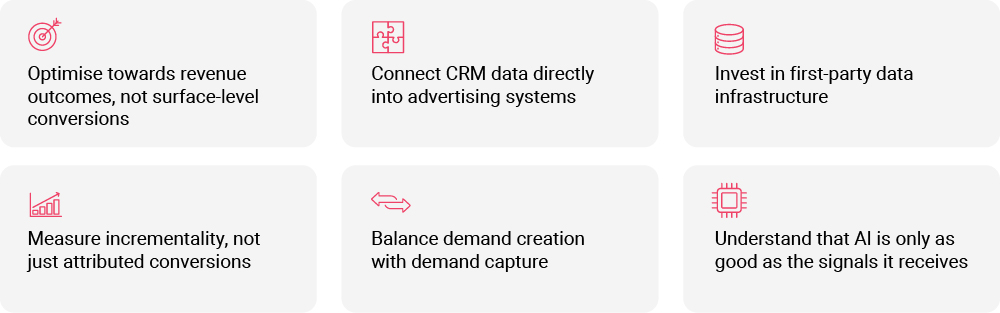
The takeaway
Technology can automate targeting, bidding and creative generation at extraordinary scale — but it still cannot compensate for weak measurement, shallow customer understanding, or a business that mistakes lead volume for commercial growth. The AI systems running your campaigns are only as intelligent as the data you feed them. Fix the signals, and the results follow.
Whether you’re struggling with lead quality, measurement gaps, or getting your CRM talking to your ad platforms — we can help you close the loop. Get in touch today.
